




Salvia Miltiorrhiza Extract Tanshinone IIA High Purity Supplier

A good botanical extract supplier does more than ship powder. For cosmetic, personal care, food and beverage, and dietary supplement brands, the real value is consistency: a clear specification, dependable stock, practical lead times, and documentation that supports quality checks.

A Clover Nutrition Inc supplies ACNS00681 Salvia Miltiorrhiza Extract, standardised by HPLC to defined Tanshinone IIA levels. With 11 years of manufacturing experience in herbal extracts, cosmetics ingredients, and high-purity natural products, the company supports buyers who need a stable source for research, formulation, pilot production, and commercial batches.
This article outlines the available specifications, sourcing considerations, quality points, and ordering details for teams evaluating a high-purity Salvia miltiorrhiza extract supplier.
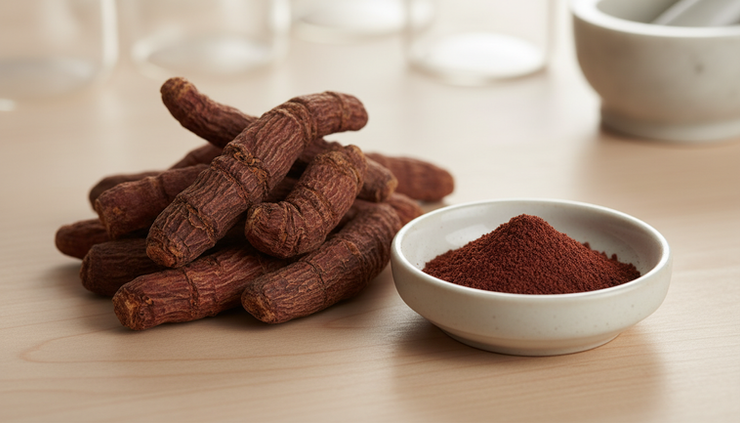
What Salvia miltiorrhiza extract is and why standardisation matters
Salvia miltiorrhiza, also known as Danshen, is a well-known botanical in traditional use and modern ingredient development. For commercial applications, buyers are usually not only looking for the raw plant material. They need a controlled extract with a measurable active marker.
That is where standardisation matters.
A non-standardised botanical extract can vary from batch to batch due to plant origin, harvest conditions, processing methods, and extraction parameters. A standardised extract gives formulators a clearer starting point. It allows purchasing, quality control, and product development teams to compare a batch against defined analytical criteria.
For ACNS00681, the key marker is Tanshinone IIA, tested by HPLC. HPLC, or high-performance liquid chromatography, is widely used to identify and quantify target compounds in botanical ingredients. When a specification states “10% HPLC”, “50% HPLC”, or “98% HPLC”, it means the content level is measured using that analytical method rather than estimated by appearance or crude ratio.
A Clover Nutrition Inc offers three main specification grades for this item:
Product code | Botanical extract | Active marker | Specification | Test method |
ACNS00681 | Salvia miltiorrhiza extract | Tanshinone IIA | 10% | HPLC |
ACNS00681 | Salvia miltiorrhiza extract | Tanshinone IIA | 50% | HPLC |
ACNS00681 | Salvia miltiorrhiza extract | Tanshinone IIA | 98% | HPLC |

The CAS number for the active marker is 568-72-9. This helps technical teams identify the compound clearly when preparing internal specifications, purchase requests, or quality documents.
The phrase Salvia Miltiorrhiza Extract, Tanshinone IIA, Tanshinone often appears in ingredient searches because buyers may be comparing the botanical source, the marker compound, and related diterpene compounds at the same time. Clear naming reduces confusion during procurement and quality review.
Three purity options for different development needs
Not every application needs the same concentration. A practical supplier should offer more than one grade so that buyers can choose according to formulation goals, budget, regulatory requirements, and processing needs.
A Clover Nutrition Inc provides three HPLC-tested options.
10% HPLC for broad formulation use
The 10% grade is often a practical choice when the formulation does not require a highly concentrated active fraction. It may suit early-stage development, blended botanical concepts, or applications where the extract contributes as part of a wider ingredient system.
This grade can be useful when a development team wants the identity and standardisation of the marker compound without moving straight to a very high-purity material.
Common reasons to evaluate the 10% option include:
Lower concentration requirements in the finished formula
Cost-sensitive product development
Need for a standardised botanical extract rather than an isolated compound
Easier blending into some formulation systems, depending on the full ingredient matrix
50% HPLC for higher marker strength
The 50% grade offers a more concentrated form and may be suitable when a stronger marker level is required. It gives formulators more active marker content per unit of raw material than the 10% grade.
This can matter when space in the formula is limited, when the total botanical load needs to stay controlled, or when developers want a more concentrated intermediate between standard extract and high-purity material.
For many technical teams, the 50% grade is a useful middle point. It gives higher strength without necessarily requiring the handling and formulation decisions associated with a 98% high-purity grade.
98% HPLC for high-purity applications
The 98% grade is the highest-purity option listed for ACNS00681. This level may be selected for specialised research, high-purity natural product work, or applications where the active marker must be present at a very high level.
High-purity ingredients need careful handling and clear documentation. Buyers should confirm the certificate of analysis, test method, batch number, storage conditions, and any additional quality data required for their internal process.
A 98% material is not simply “better” in every situation. It is more concentrated. The right choice depends on the intended use, formulation system, target specification, and compliance pathway.

Supply details that matter to purchasing teams
Procurement teams often need quick answers before they can move a supplier forward. Availability, lead time, minimum order quantity, and sample policy are not small details. They affect development schedules and launch planning.
For ACNS00681 Salvia miltiorrhiza extract, A Clover Nutrition Inc lists the following supply information:
Supply detail | Information |
Product code | ACNS00681 |
Active marker CAS | 568-72-9 |
Available specifications | 10% HPLC, 50% HPLC, 98% HPLC |
Current stock | 450 kg |
Lead time | 2 to 4 working days |
MOQ | 1 kg |
Sample | Available based on required quantity |
A current stock level of 450 kg gives buyers room to plan beyond a single small test order. It can support sample checks, pilot batches, and follow-up purchasing, subject to specification confirmation and batch availability at the time of order.
The stated 2 to 4 working day lead time is also useful for teams that need a fast response after approval. Lead time can still depend on order size, documentation needs, shipping method, and destination requirements, so it is best to confirm details when placing an enquiry.
The 1 kg MOQ makes the material accessible for development and small-scale commercial work. Many ingredient projects start with lab evaluation before moving to larger batch commitments. A lower MOQ can reduce waste and give teams time to perform internal testing.
Samples may be offered based on the required quantity. When requesting a sample, it helps to provide the intended grade, planned application, estimated annual demand if known, and any documentation required for evaluation.
Quality checks buyers should request before ordering
A supplier relationship becomes easier when both sides are clear about quality expectations from the start. For botanical extracts, the certificate of analysis is only one part of the review. It is a critical part, but buyers may also need supporting documents for their own compliance systems.
For a high-purity material, request documents and details that match the intended use. These may include:
Certificate of analysis for the exact batch
HPLC test data for the declared specification
Product specification sheet
Safety data sheet
Allergen or GMO statements, if required
Heavy metal and microbiological data, where relevant
Residual solvent information, if applicable
Storage and shelf-life guidance
Country of origin and manufacturing details
Documentation needs differ by market and application. Cosmetic, personal care, food and beverage, and dietary supplement buyers may have different internal standards. The right time to ask for required documents is before placing a full order, not after the shipment has arrived.
For cosmetic and personal care applications, formulators may also need to check colour, odour, solubility, compatibility, and stability in the final system. Botanical extracts can affect the look and feel of a formula. A reddish-brown extract, for example, may not be suitable for every clear or pale-coloured product without adjustment.
For nutraceutical or food-related applications, the review may be broader. Teams often need to consider local laws, permitted use, labelling rules, contaminant limits, and any market-specific restrictions. This content is for ingredient information only and does not make medical or therapeutic claims.

Why choose A Clover Nutrition Inc as a supply partner
A Clover Nutrition Inc has more than 11 years of manufacturing experience in herbal extracts and high-purity natural products. The company serves several ingredient markets, including cosmetics, personal care, food and beverage, and dietary supplements.
That range matters because botanical ingredient buyers often need a supplier who understands different quality expectations. A cosmetic raw material enquiry may focus on formulation behaviour and appearance. A dietary supplement ingredient enquiry may focus more on content assay, contaminant limits, and suitability for the intended product category. Food and beverage teams may have their own priorities around taste, colour, and processing conditions.
A Clover Nutrition Inc positions itself as a one-stop solution for cosmetics ingredients and high-purity natural products. For buyers, the practical benefits include:
Multiple specification choices for the same active marker
Available stock for faster order planning
Manufacturer experience rather than simple trading support
Sample availability for evaluation
Support across several ingredient categories
The company is based in Xi’an, Shaanxi, China, an area known for botanical ingredient manufacturing and raw material supply networks. Location alone does not guarantee quality, but proximity to established ingredient production channels can help support sourcing, processing, and technical communication.
When comparing suppliers, buyers should look beyond a low unit price. A lower price may not help if the extract fails internal testing, has unclear documentation, or cannot be supplied at the same specification for repeat orders. Consistency, communication, and batch traceability all carry real value.
Practical ordering guidance for ACNS00681
Before requesting a quotation, it helps to prepare the basic technical and commercial details. This saves time and gives the supplier enough information to recommend the right grade.
A useful enquiry should include:
Required specification Choose 10% HPLC, 50% HPLC, or 98% HPLC.
Required quantity State whether the request is for sample testing, pilot production, or regular supply.
Intended application Mention cosmetic, personal care, food and beverage, dietary supplement, or research use.
Documentation needs Ask for COA, specification sheet, SDS, or other documents required by your internal process.
Delivery destination Provide the country or region so the supplier can comment on shipping options.
Timeline Share the target delivery date if the project is time-sensitive.
For sample requests, be clear about the amount needed. A lab may only need a small amount for identity and solubility checks, while a stability trial or pilot batch may require more. The sample policy is based on required quantity, so clear information improves response time.
If the project is moving towards commercial production, ask whether the same batch can support both evaluation and scale-up, or whether a reserved quantity is possible. This can reduce the risk of approving one batch and purchasing another without comparison.
For repeat orders, build a habit of checking the batch COA and specification every time. Even when the supplier is reliable, incoming quality control protects the final product and keeps records complete.

Contact A Clover Nutrition Inc for specification and samples
A Clover Nutrition Inc supplies ACNS00681 Salvia miltiorrhiza extract in 10% HPLC, 50% HPLC, and 98% HPLC grades, with current stock listed at 450 kg, a 1 kg MOQ, and a typical lead time of 2 to 4 working days.
For technical documents, quotation requests, and sample enquiries, contact the team directly:
Enquiry type | Contact |
Company | A Clover Nutrition Inc |
Sales enquiry | sales@clovernutrition.com |
General enquiry | info@clovercn.com |
Phone | 0086-29-81875649 |
0086-15399017060 |
A well-specified botanical extract can make product development easier from the first sample to repeat supply. For teams seeking a high-purity Salvia miltiorrhiza extract supplier, ACNS00681 offers clear HPLC-tested options, practical order quantities, and manufacturer support for several ingredient markets.


Comments